Follow the Credit System Step-by-Step
Educational content only. Not credit repair advice or services. No guarantees made. See full Disclaimer
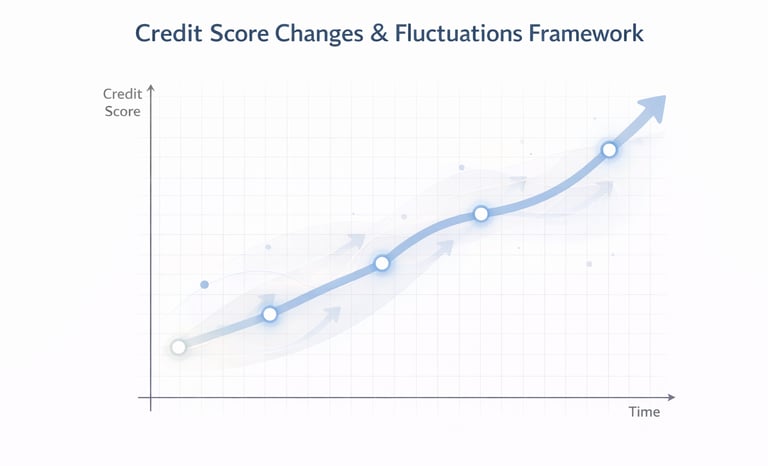
Credit Score Changes & Fluctuations Framework
This page is part of the Credit Patterns Framework — a step-by-step system designed to explain how credit scores are calculated, interpreted, and updated over time.
How Credit Scores Are Dynamic and What Influences Reported Fluctuations
Credit scores are not fixed numbers.
Many people notice their score changing from one month to the next — sometimes even when nothing obvious has changed. You might see a drop, an increase, or just small fluctuations and wonder what caused it.
This guide explains how credit scores change over time, what reported data influences those changes, and how scoring models interpret updates — without offering advice, services, or guarantees.
This page is part of the CreditPatterns.com Credit Education Framework, a structured system designed to explain how credit data is interpreted across scoring models.
🧠 Who This Page Is For?
This page is designed for:
Individuals who notice their credit score changed unexpectedly
People reviewing score updates and wondering what caused the change
Anyone tracking their credit data over time
Individuals seeking clear, factual explanations of score fluctuations
This is an educational guide only — no strategies or recommendations are provided.
📊 In This Guide
Why credit scores are dynamic
How scoring models recalculate scores
Reporting cycles and score updates
Common causes of score fluctuations
Expected vs unexpected changes
How different factors interact
Differences between scoring models
Common fluctuation patterns
Why timing creates confusion
Monitoring score changes
Frequently asked questions
Why Credit Scores Are Dynamic
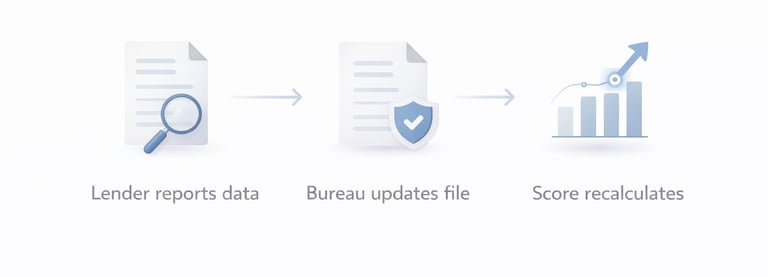
Credit scores are recalculated whenever new or updated information is reported to the credit bureaus.
Because credit reports are constantly changing — balances, payments, new accounts, and other updates — scores also change.
Scores do not update continuously in real time.
They update when new data is reported.
Featured Snippet:
Credit scores can change when new information is reported to credit bureaus, such as updated balances, payments, or new accounts.
How Scoring Models Recalculate Scores
Each time new data is reported, scoring models take a new snapshot of your credit file.
They do not gradually adjust your score.
Instead:
A new snapshot of your credit data is created
That snapshot is evaluated using the scoring model
A completely new score is generated
🧠 Key Point
Credit scores do not “move up or down” on their own.
Each change reflects a new calculation based on updated data.
Reporting Cycles and Score Updates
Most lenders report account information to credit bureaus on a monthly basis.
Because of this:
A payment made today may not appear for 30–60 days
A balance reduction may not show until the next reporting cycle
New accounts or inquiries may appear sooner
This delay is one of the most common reasons score changes feel confusing.
Common Causes of Credit Score Fluctuations
Score changes are usually tied to updates in reported data.
Common causes include:
Changes in credit utilization (balances or limits)
New accounts or credit inquiries
Late payments or other negative items
Aging of accounts or negative items
Corrections or updates to reported information
Often, multiple updates happen at the same time — for example:
👉 A balance increase + a new inquiry + a new account
Expected vs Unexpected Score Changes
Some changes are expected:
Normal spending or balance changes
Opening a new account
Payments being reported
Other changes may feel unexpected:
Timing differences in reporting
Reporting delays or inconsistencies
Differences between credit bureaus or scoring models
This helps explain why scores can change even when behavior stays the same.
How Different Factors Work Together
Credit scores reflect multiple factors interacting at once.
Examples:
A balance increase raises utilization → often associated with lower scores
A new inquiry and new account → affects both new credit and account age
A late payment combined with high utilization → stronger combined impact
👉 See related topic: Credit Utilization & Credit Card Behavior
👉 See related topic: Credit Report & Negative Items Framework
Differences Between Scoring Models
Different scoring models interpret changes differently.
FICO models
Focus on specific data updates like utilization, payment history, and new credit
VantageScore models
Place more emphasis on trends over time
Because of this, the same credit data can produce different score changes depending on the model used.
Common Observable Patterns
Based on historical model data:
Scores may decrease after higher utilization is reported
Scores may change after new inquiries or accounts
Temporary fluctuations can occur around payment timing
Scores may gradually improve as negative items age
These are commonly observed patterns — not guaranteed outcomes.
Why Timing Creates Confusion
Timing plays a major role in score fluctuations.
Reporting is not real-time
Different bureaus update at different times
Statement dates affect reported balances
Payments may post after reporting
This can create short-term changes that don’t reflect long-term behavior.
How Data Changes Translate Into Score Changes
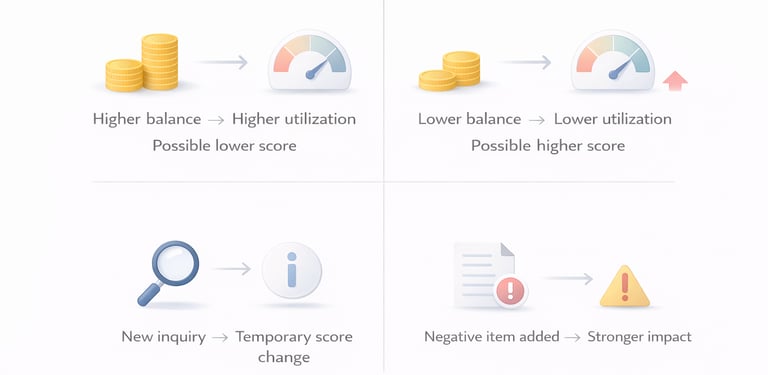
Here’s how common changes typically appear:
When balances increase → utilization rises → often associated with lower scores
When balances decrease → utilization drops → often associated with higher scores
When a hard inquiry is added → temporary change may occur
When a new account is opened → average account age may decrease and multiple factors may be affected
When a negative item is added → payment history is impacted → often stronger effect
When a negative item ages → its impact may gradually decrease over time
These examples illustrate how scoring models interpret data — not direct cause-and-effect rules.
👁️ Tracking Credit Score Changes Over Time
Credit scores do not change randomly. They are recalculated based on updated data, which means even small changes in balances, payment timing, account activity, or reporting cycles can result in different outcomes.
Because multiple factors often change at the same time, it can be difficult to isolate what caused a specific score movement without viewing how data is updating across your full credit profile.
For example, a score change may reflect a combination of utilization updates, new account activity, or aging data — all interacting within the same reporting cycle.
Observing these changes over time can help reveal patterns in how scoring models respond to different types of updates rather than focusing on a single event.
Credit Monitoring Tool (Advanced Tracking)
Track score changes, account updates, and reporting patterns over time
👉 Track your credit changes and score behavior over time Affiliate Disclosure
This tool allow individuals to observe reported data and score changes over time.
However, results may vary depending on:
The scoring model used
The credit bureau providing the data
The timing of updates
👉 Learn more: Credit Monitoring & Credit Tools
👉 Related: Credit Utilization & Credit Card Behavior
👉 Related: Credit Report & Negative Items Framework
🧠 Key Takeaway
Credit scores are dynamic.
They reflect the most recent snapshot of your credit report — not a fixed number.
Fluctuations occur when new or updated data is processed, and each change represents a new calculation based on that data.
❓ Frequently Asked Questions
Why did my credit score change?
Scores can change when new information is reported, such as balances, payments, inquiries, or new accounts.
How often do credit scores change?
They can change whenever new data is reported, typically on a monthly cycle.
Why did my score drop even though I paid on time?
Changes may be related to utilization, new accounts, inquiries, or other reported updates.
Why did my score go up suddenly?
Increases may be associated with lower utilization or aging of negative items.
What causes monthly fluctuations?
Monthly updates, reporting cycles, and timing differences.
Does paying off a credit card change my score?
Lower balances may reduce utilization, which is often associated with score changes when reported.
How long does it take for a payment to affect my score?
Typically after the next reporting cycle (about 30–45 days).
Can a score change without new activity?
Yes — due to aging accounts, data updates, or corrections.
Are credit score fluctuations normal?
Yes — fluctuations are a normal part of how scoring models process updated data.
← Previous Step: Credit Report & Negative Items
Next Step → Credit Monitoring & Tools
🔗 Explore the Credit Education Framework
This page is part of a connected system of educational resources:
Each section explains one component of how credit scoring models interpret real-world credit data.
⚠️ Final Disclaimer
THIS ARTICLE IS PROVIDED FOR GENERAL EDUCATIONAL PURPOSES ONLY AND IS NOT CREDIT REPAIR ADVICE, CREDIT REPAIR SERVICES, FINANCIAL ADVICE, OR PERSONALIZED GUIDANCE. CreditPatterns.com does not: Offer credit repair services, Dispute credit report items, Provide credit improvement assistance. Accurate negative information cannot be removed from credit reports under federal law. For questions about your credit report, contact: Equifax, Experian, TransUnion Or consult a qualified professional.