Follow the Credit System Step-by-Step
Educational content only. Not credit repair advice or services. No guarantees made. See full Disclaimer
Credit Mix & Account Types Framework
This page is part of the Credit Patterns Framework — a step-by-step system designed to explain how credit scores are calculated, interpreted, and updated over time.
How Revolving and Installment Accounts Are Interpreted in Credit Scoring Models
Many individuals have a mix of credit accounts — credit cards, auto loans, student loans, mortgages — yet still don’t fully understand how that mix is interpreted.
Credit scoring systems do not simply look at how many accounts you have. They evaluate what types of credit behavior are present, how those behaviors differ, and how they interact over time.
This page explains what credit mix means, how different account types are reported, and how they are interpreted within scoring models such as FICO and VantageScore — without offering advice, services, or guarantees.
This page is part of the CreditPatterns.com Credit Education Framework, a structured system designed to explain how credit data is interpreted across scoring models.
Who This Page Is For
This page is designed for:
Individuals with both credit cards and loans who want to understand how account diversity is viewed
People with only one type of credit (e.g., only credit cards or only loans) noticing score differences
New credit users building a profile and trying to understand how different accounts appear
Anyone seeking a clear, non-promotional explanation of how credit mix works
This is educational content only — no strategies or recommendations are provided.
In This Guide
What credit mix actually represents
Types of credit accounts
Revolving vs installment credit
How account types are reported
How scoring models interpret credit mix
Behavioral diversity vs account quantity
Common observable patterns
How credit mix interacts with other factors
Monitoring credit mix over time
Frequently asked questions
What Is Credit Mix?
Definition
Credit mix refers to the variety of account types present in a credit profile, such as revolving accounts (credit cards), installment loans (auto, personal, student), and mortgages.
Featured Snippet: What is credit mix in credit scoring?
Credit mix refers to the variety of account types in a credit profile, such as revolving credit and installment loans, and is used in scoring models to evaluate diversity of credit behavior.
🧠 Core Insight: Credit Mix Is Behavioral Diversity
Credit mix is not about how many accounts exist — it is about how many different types of credit behavior can be observed.
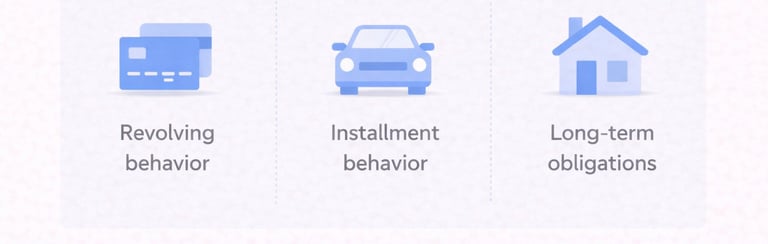
Each account type represents a different pattern:
Revolving accounts → variable balances, flexible repayment
Installment loans → fixed payments over time
Mortgages → long-term structured obligations
Scoring models are not just counting accounts — they are evaluating how many distinct financial behaviors exist within a profile.
This is why two people with the same number of accounts can have very different profiles depending on the types of accounts present.
Types of Credit Accounts
Common account types include:
Revolving credit
(Credit cards, HELOCs)Installment loans
(Auto loans, personal loans, student loans)Mortgage loans
(Primary home loans, home equity loans)Retail/store accounts
(Merchant-specific revolving accounts)Finance company accounts
(Specialized lending institutions)
Each of these contributes a different behavioral pattern to the overall profile.
Revolving vs Installment Credit
Revolving Credit
Borrow up to a limit
Balance can increase or decrease
Minimum payments required
Utilization is calculated (balance ÷ limit)
Installment Credit
Fixed amount borrowed
Fixed monthly payment
Defined payoff timeline
No utilization ratio
🧠 Key Distinction
Revolving credit shows how you manage ongoing access to credit
Installment credit shows how you manage structured repayment over time
These are fundamentally different behaviors — and are evaluated differently.
How Credit Mix Is Reported
Credit account types are reported to credit bureaus by creditors using standardized data fields:
Account type classification
Open date
Balance and limit (for revolving)
Payment status
Account status (open, closed, paid)
Scoring models analyze the presence, distribution, and interaction of these account types — not just their existence.
Credit Mix in Scoring Models
FICO Models
Credit mix accounts for approximately 10% of the score
“Credit mix accounts for about 10% of your score.” — myFICO.com
VantageScore 4.0
Credit mix is included within Depth of Credit (~20%)
Greater emphasis on overall profile structure and diversity over time
Featured Snippet: How important is credit mix?
Credit mix accounts for approximately 10% in FICO models and is included within depth of credit (~20%) in VantageScore models.
Credit Mix vs Credit Quantity
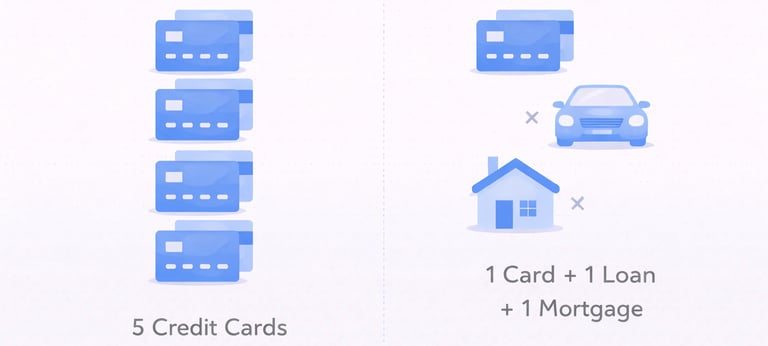
Credit mix is about variety, not volume.
Multiple credit cards = same behavior type
One credit card + one auto loan = two behavior types
Adding more of the same account type does not significantly increase behavioral diversity.
This is one of the most misunderstood aspects of credit scoring.
Common Observable Patterns in Credit Mix
Based on historical model data, patterns often observed include:
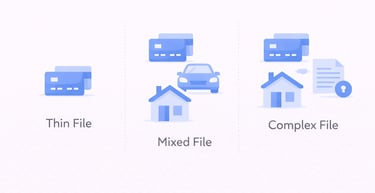
Profiles with both revolving and installment accounts appear more developed
Profiles with only one type may show more variability
Adding a new account type may correspond with temporary changes
Mixed profiles (revolving + installment + mortgage) may appear more stable over time
These are patterns observed in model data — not rules or guarantees.
How Credit Mix Interacts With Other Factors
Credit mix does not function independently. It interacts with:
Credit age
→ New account types may reduce average ageNew credit activity
→ Adding a new type often involves an inquiry
See Credit Inquiries & New Credit Activity FrameworkCredit utilization
→ New revolving accounts affect utilization ratios
See Credit Utilization & Credit Card Behavior guideNegative items
→ Behavior across different account types may be evaluated differently
See Credit Report & Negative Items FrameworkScore fluctuations
→ New account types can influence short-term changes
See Credit Score Changes & Fluctuations Framework
Why Credit Mix Contributes to Profile Structure
Credit mix helps define the structure of a credit profile, not just its performance.
It allows scoring models to evaluate:
Behavioral diversity
Long-term consistency across account types
Ability to manage different forms of credit
This contributes to how complete or “developed” a credit profile appears in model data.
👁️ Viewing Credit Mix in Your Profile
Credit mix is reflected in how different account types are reported within your credit file, including revolving accounts, installment loans, and other account categories.
Because these account types are recorded over time, reviewing your credit profile can help clarify how different types of credit are represented and how they interact within your overall credit data.
For example, your profile may show a combination of credit cards, loans, and other accounts, each contributing a different type of behavior pattern. Observing how these accounts are reported can help connect how credit mix is interpreted within scoring models as part of a broader system.
Credit Monitoring Tool
Review your account types, balances, and overall credit profile structure
👉 View your full credit profile and account mix Affiliate disclosure
This tool allows monitoring of reported account types, but scores and interpretations may vary depending on model, bureau, and timing.
Related Guides
👉 Complete Credit Scoring Education Framework
👉 Credit Age & File Depth Framework
👉 Credit Inquiries & New Credit Activity Framework
👉 Credit Utilization & Credit Card Behavior
👉 Credit Score Changes & Fluctuations Framework
Key Takeaway
Credit mix reflects the variety of credit behaviors present in a profile — not just the number of accounts.
It contributes to how scoring models interpret:
Behavioral diversity
Profile structure
Long-term stability
It is one component of a broader system that evaluates credit data over time.
Frequently Asked Questions (FAQ)
What is credit mix?
Credit mix refers to the variety of account types in a credit profile, such as credit cards, loans, and mortgages.
Does credit mix affect credit scores?
Yes, it is a smaller factor — approximately 10% in FICO and part of depth of credit in VantageScore.
What is the difference between revolving and installment credit?
Revolving credit allows flexible borrowing up to a limit, while installment credit involves fixed payments over a set period.
Does having more accounts improve credit mix?
Not necessarily — variety of account types matters more than quantity.
Does opening a new loan change credit mix?
Adding a new type of account may increase diversity, but may also affect other factors like age and inquiries.
Do closed accounts still count toward credit mix?
Closed accounts may continue to contribute to the overall profile depending on the model and reporting.
Is credit mix more important than payment history?
No, payment history is generally the most significant factor in scoring models.
Can credit mix change over time?
Yes, as new account types are added or older accounts age or close.
← Previous Step: Credit Age & File Depth
Next Step → Credit Inquiries & New Credit Activity
🔗 Explore the Credit Education Framework
This page is part of a connected system of educational resources:
Each section explains one component of how credit scoring models interpret real-world credit data.
Final Disclaimer
THIS ARTICLE IS PROVIDED FOR GENERAL EDUCATIONAL PURPOSES ONLY AND IS NOT CREDIT REPAIR ADVICE, CREDIT REPAIR SERVICES, FINANCIAL ADVICE, OR PERSONALIZED GUIDANCE. CreditPatterns.com does not: Offer credit repair services, Dispute credit report items, Provide credit improvement assistance. Accurate negative information cannot be removed from credit reports under federal law. For questions about your credit report, contact: Equifax, Experian, TransUnion Or consult a qualified professional.